CLAN FRASER SOCIETY  
OF CANADA

FOUNDED IN CANADA IN 1868


Fraserville or Rivière-du-Loup

Ancestry of Malcolm Fraser  (1733-1815)

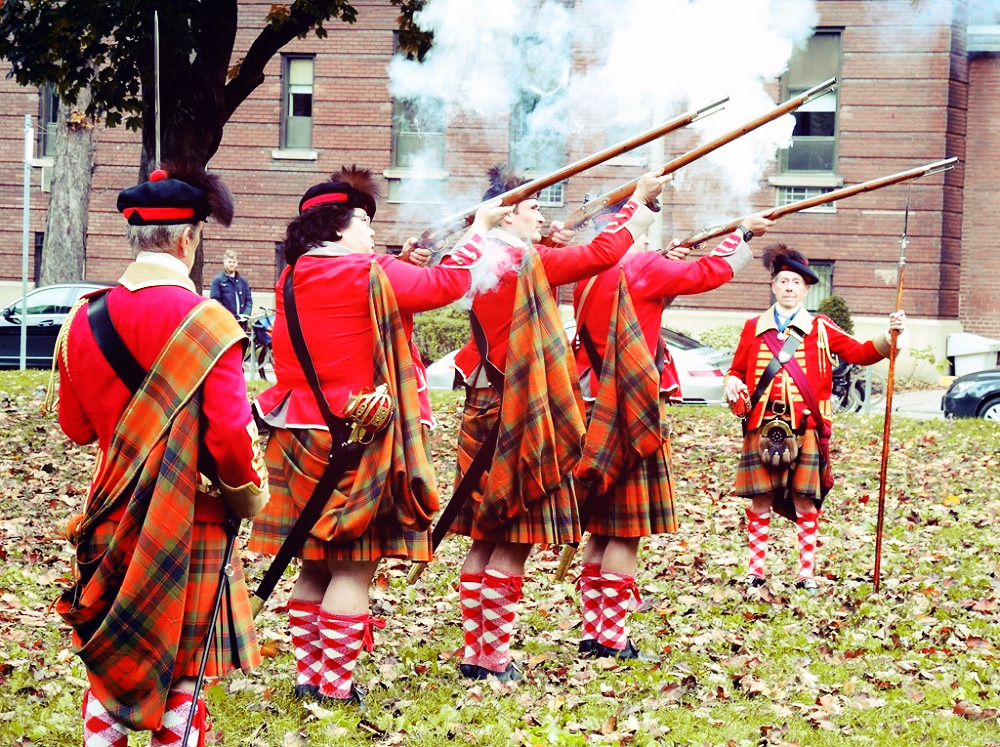
According to family tradition, Malcolm’s father Donald was killed at the battle of Culloden in 1746.  On July 8, 1757 Malcolm Fraser from Abernethy, Strathspey was gazetted an ensign in the 2nd Highland Battalion, also called 63rd Regiment of Foot and 78th Regiment of Foot (Fraser’s Highlanders).    He was wounded at the battle of the Plains of Abraham on September 13, 1759, promoted to lieutenant on September 25, 1759, and again wounded at Ste-Foy on April 28, 1760.   After the regiment was disbanded in 1763, he purchased the seigniory of Mount Murray from James Murray.   With the outbreak of the American Revolution, Malcolm Fraser helped to recruit former Fraser Highlanders for the 1st Battalion, 84th Regiment (Royal Highland Emigrants), in which he was gazetted a captain on June 24, 1775.   In 1797 he was Brevet Major and Captain in the 1st Battalion, 60th Regiment of Foot but, as the regiment was ordered to embark for England [August 3, 1798 Military papers, C931, p. 106-107], and he wished to remain in Canada, he resigned, and “the sale of his commission was ratified in the London Gazette”  [October 8, 1798 Military papers, C931, p. 109-109a].

Little is known about Ontario Archivist Alexander Fraser (1860-1936) who emigrated to Canada in 1886, except that he was the eldest son of Hugh Fraser, of the Frasers of Little Struie, and of Mary (Maclean) Mackenzie of Fanellan [The Celtic Monthly, No. 1, Vol. XX, January 1912, pp. 1-2].  Alexander Fraser claimed descent from the Clan Mhic Fhionnlaidh sept of the Struy Frasers and called his Toronto home “Kineras".

In October 1933, in his capacity as Archivist of Ontario, Alexander Fraser wrote to Captain Jack Fraser, son of Archibald Fraser and grandson of William Fraser (1830-1908):
“When I left the Old Country for Canada, as I have probably told you years ago, I was asked very earnestly by a relative to trace the descendants of Malcolm Fraser as there was some connection.   The name of the place in the Old Land where Malcolm Fraser was born, and which is now in the hands of a relative of mine, is Bredaig in my native parish of Kiltarlity on the Lovat Estates...
P.S.  I have always felt that Professor Wrong did but scant justice to the Fraser family but the papers which he had were chiefly those of the Nairnes."

In November 1933, he wrote to Alice (Fraser) Prevost:
“I do not understand the note which gives the descent of Malcolm Fraser from James Fraser of Strathspey.  I cannot trace a James Fraser in Strathspey who belonged even distantly to the old Lovat family.  I have also searched in the genealogy of the present Lovat family which belonged to the Strichen branch, but can find no James Fraser among them.   The Strichen branch, while succeeding to the estates and ultimately to the title, was 220 years removed from the parent or old Lovat stock, but the intervening families in the main line are all accounted for and I cannot work out among them all a James Fraser of Strathspey.  Should there have been such a James Fraser, and should it be that Malcolm Fraser was his descendant as stated in the memo by William Fraser, then my information from my relatives in the Aird of Lovat that Malcolm Fraser’s father occupied Brideag must be held as incorrect..."

In January 1934, he again wrote to Mme Prevost:
"I have just heard from the Rev. Dr. Archibald McDonald who was once minister of my native Parish and is now living near Edinburgh – quite an old man.   He undertook a search regarding Malcolm Fraser.   He failed to find any trace of Malcolm Fraser in the Edinburgh University lists from 1747 to 1757..." 
[Ed: After Culloden, Malcolm was sent by his uncle to France, where he studied for the law - private family papers.]
“Dr. McDonald personally knew two clergymen of the name of Fraser and one of the name of Fraser who was at one time Chief Constable of Argyle.   These were from the family that had settled at Abernethy Strathspey and who they said were originally from the farm of Achvaich in my native Parish.  So that after all the Strathspey Frasers and the Frasers of Brideag may have been relatives and might account for the tradition.  Dr. McDonald advises me not to abandon the Brideag tradition at least in the meantime..." 
[Ed: The Rev. Archibald Macdonald, D.D. (1853-1948) wrote The Old Lords of Lovat and Beaufort (1934), The Clan Donald &c.  Marjory Robertson Fraser (dsp 1916), d/o James Fraser, Chief Constable of Argyllshire, married in 1906, as his first wife, Rev. Neil MacLellan (1877-1935), minister at Inverness, 2nd Charge.]

Malcolm Fraser’s journals provide a first-hand account of the British conquest of Canada and his stature among his fellow soldiers has been well documented.   However, in spite of the exaggerated lineage attributed to him, Malcolm Fraser was circumspect about his personal life.   He corresponded over a thirty-year period with Rev. John Grant (1740-1820), Minister of Abernethy (1765), through whom he regularly sent money to the families of his sister Janet and his half-sister Sarah, but it was not until he was reproached by his old friend, that he let down his guard, in a letter dated 13th June 1802:

“Your letter of 29th July 1801 did not come to my hand till 31st December last and as I was then at a place called Malbay about 100 miles from this place where I reside and being unable to come here myself there being hardly any communication and no road for me to come by and as I could not make a proper Answer till I knew how my money concerns stood both here and in London, I hope this will plead my excuse for having delayed to answer your Letter till now.

“It gave me great pleasure to hear from you and to find that you are well and that I have given you no offense which I was much afraid of by your failure to correspond with me for several years tho’ I wrote you more than once.   I last sent Post by one Letter which I had reason to think must have come to your hands as I gave it myself in London [Winter of 1796] to a Mr Robert Grant who had made a fortune in this Country and was going to Strathspey where he was born and where I was sorry to learn he has died.  But as I had no answer I own I did not write you since.   I believe I wrote you that I had been obliged to go to London where I remained near two years to recover my half pay which had apparently been stopped for about two years on account of some supposed errors in my Accounts as I was assigned to the late 84th Regt in which I served during the American War but I at last cleared up all those matters and not only recovered my half pay but also got on full pay and remained so for about four years when I got leave to sell and did pull out and tho’ I have not made what I would in the present times call a fortune I am thank God in hood health considering my advanced age and I have no reason to complain… [He advises that he has sent money to his relations through Mr Fraser of Ford]...

“Tho’ I was taken away from thence about sixty years ago I have ever had a regard and done any thing in my Power for any one I met with from any part of Strathspey.    I know that my foregone ancestors had lived for some generations on lands which they held among the honorable family Grant and I was told that they were for a long time in possession of a tack on the south parish of Spey which is on land between Culnahoe and Achnacharnich and I think they left there in the year 1736 and settled in Abernethy which was called the Frasers seat but as that part of the tribe became extinct in that quarter I suppose there is hardly any person now alive in the parish who remembers anything of the matter...

“By the bye when you do me the honour to write next I wish you to be so good as to send me a Certificate of my birth and Baptism which I think I saw on record in your parish register as having been on the 15th day of May Old Style 1733 and I took a Certificate of it which I have lost.  I remember having heard a tradition that the last two boys of this tribe to which I belong came to Strathspey along with their mother who was the widow of a Fraser of Foyers in Stratherrick and who was married after the death of her first husband to a Grant of Tulloch.   That those two young men settled in Abernethy, the one named Alexander and the other Duncan [Fraser].   That the Descendants of the first of whom I am sprung were called Clan Vic Jh vic Alister [John s/o Alexander] and those of the other Clan Vic Ian Vic Conachie [John s/o Duncan].    This may perhaps be all a fiction but I am certain of having heard it many times repeated as a truth and that I believe it.   I beg the favour of you to make some Enquiry about this weighty matter with some of the oldest people in your parish and to write me an account of whatever you can learn on the subject..."

Contrary to the delusions of his grandson, John Fraser de Berry (1816-1876), there is no evidence to suggest that Malcolm Fraser succeeded in tracing his roots through his correspondence with Rev. John Grant in Abernethy, Strathspey.

Family of Malcolm Fraser in Canada

In his 1992 article  Finding Mary Allaire The French (and German) Ancestry of John B. McLoughlin  [published in English and French by the Quebec Family History Society], George T. Brown notes that John B. McLoughlin (or Jean-Baptiste), later known as the Father of Oregon, was the son of John McLoughlin and Angélique Fraser.   Angélique was the daughter of the common-law liaison between Malcolm Fraser, a lieutenant in the Fraser Highlanders during the Conquest and later Laird of Mount Murray (Malbaie) and Mary (Marie) Allaire.   Malcolm was a staunch Presbyterian and comrade-in-arms to John Nairne.   George Brown notes that Mr Lizotte attributes six children to the Allaire-Fraser liaison including Juliana or Julienne; he further contends that all the children of Malcolm Fraser’s liaisons, except possibly Juliana, were baptized in the Catholic faith.   Yet, when Malcolm had custody of the children at Mount Murray he raised them in the Protestant faith.

By Marie-Louise Allaire, known as Marie, (1739-1822), Malcolm Fraser had Angélique (1761-1842); Alexander (1763-1837); Joseph (1765-1844); Simon (1768-1844); Marguerite (Apr-Jul 1770); and Juliana (1772-1847).   [Marie-Louise Allaire had a younger sister, born in 1749, also named Marie-Louise, who was known as Louise.]

By Marie-Josephte Ducros (1763-1837), referred to as Marguerite in Mr Lizotte’s book on Rivière-du-Loup, Malcolm Fraser had Anne (1792-1877); William (1794-1830); Marguerite (1797-bef.1812); and John Malcolm (1800-1836).  There is a hand-written certificate by Rev. Lecourtois, giving the names and dates of birth of Malcolm Fraser’s children by Marie Ducros, dated at Les Escoumains on 7 April 1855.  [Marie-Josephte Ducros was the same age as her step-son Alexander Fraser, whom she predeceased by two months.]

Just when we felt that nothing more could possibly be discovered about Malcolm Fraser (1733-1815), progenitor of this fascinating family in Canada, a new door has opened.

The latest chapter began with Paul Lessard and Jean-Claude Massé collaborating on their research about Malcolm Fraser and his daughters, Angélique and Juliana.

Paul had located a document dated 16 July 1762 [Notary Antoine-Jean Saillant] covering the sale of land to Angélique Fraser, then a baby in her first year of life.   Her grandmother, Marie-Joseph Molleur, acted for the child, whose mother, Marie Allaire, was also part of the contract.   This was supplemented by another notary contract dated 8 Nov 1771 [Notary Jean-Claude Panet], discovered by his colleague, whereby Malcolm Fraser gave lands situated at Beaumont to Miss Marie Allaire, asking her to take care of their children, namely, Alexander, Joseph, Simon and Angélique, as well as her mother, Marie-Joseph Molleur.   They got the distinct impression that this was an act of separation between Malcolm and Marie.   If so, who was the mother of Juliana, born later?

A document found in the Quebec Register Books, dated 10 July 1773, revealed the sale of land situated at Rivière-du-Loup by Richard Murray to Malcolm Fraser and Margery his wife.    It was very intriguing.   Was this a new wife and the mother of Juliana?   What was her family name?   The clue was contained in a draft letter, dated 22 July 1814 [Fonds Fraser], written by Malcolm Fraser to John McCord about Juliana and the recent death of Patrick Langan.  Malcolm referred to “your niece and my daughter”.   The logical conclusion was that the mother of Juliana was a sister of John McCord, merchant of Quebec.    Paul found a Margaret McCord married to Josiah Bleakley in Quebec St Andrew’s in 1798.   At her death in 1829, she was 63 years old, so she was born about 1766 and could not have been the mother of Juliana.

The last will of John McCord, dated 1st Oct 1817 and probated 26 Jan 1822, revealed that Juliana and Charlotte Langan were named as beneficiaries, but no relationship was given.   Nevertheless, it was clear that they were part of the family.   The answer finally came in a book about the McCord family written in 1992 and published by the McCord Museum.   Malcolm Fraser and Margery McCord had their place in the family chart.   On page 31, it was written “Margery married Malcolm Fraser”.    On page 33, it was noted that John McCord sold the family property “to his brother-in-law, Malcolm Fraser” and that Thomas McCord “placed his affairs in the care of his nephew by marriage, Patrick Langan."   There was no doubt that Juliana Fraser was the daughter of Malcolm Fraser and Margery McCord, whose sister Jane had married Alexander Fraser of Beauchamp.

A chart showing the new family connections of Lieut. Alexander Fraser of the 78th (c1729-1799), Lieut. Malcolm Fraser of the 78th (1733-1815), Volunteer John Ross of the 78th and Thomas McCord, merchant of Quebec (1750-1824), is included in the December 1999 issue of   Canadian Explorer, together with a chart of the Fraser Family of Mount Murray & Rivière-du-Loup.

Alexander Fraser of Beauchamp  (c1729-1799)

According to the  Dictionary of Canadian Biography, Vol. 4 (p. 276):  Untangling the several Alexander Frasers who served with the 78th Foot in the campaigns of the Seven Years’ War has been a perennial problem.

This Alexander Fraser was commissioned Lieutenant 12 Feb 1757, wounded at the battle of the Plains of Abraham on 13 Sept 1759 and Ste-Foy in April 1760.   He remained in Canada when the regiment was disbanded in 1763 and purchased from Brig-General James Murray, the seigneury of La Martinière, later acquiring other property.   About 1765 he married Jane McCord, who died in 1767, leaving him to raise two infant daughters, Margaret and Jane..."

According to the Army List [War Office, 4th of June, 1779], John Nairne, Alex. Fraser and Malcolm Fraser were commissioned Captains 14 June 1775 in the 84th Regiment of Foot, or Royal Highland Emigrants, 1st Battalion, America; with John Nairne promoted Major 29 Aug 1777.    The Royal Highland Emigrants were placed on the British regular establishment as the 84th Foot on 1 April 1779.   Alexander Fraser, late Captain in His Majesty’s 84th Regiment of Foot, died at St-Charles on the nineteenth instant, aged about seventy years, and was buried at Quebec St. Andrew’s on 22nd April 1799.

His daughter Margaret Fraser (c.1766-1807) married John Reid (1765-1827), without issue.  Jane Fraser (c.1767-1790) married Arthur Davidson (1743-1807), with issue: Jane, born 10 Dec and baptized 23 Dec 1785; Eliza, born 16 Apr and baptized  1 May 1787; and Walter, born  7 Aug and baptized  26 Aug 1790.   In 1799 Arthur Davidson married secondly, Eleanor Birnie (1756-1837), who survived him and, after 30 years in Montreal, she returned dutifully but unwillingly in 1822 to be a companion to her two elderly sisters in Ballymena, Ireland, where she died.

On 25 June 1791 Alexander Fraser gifted the land and seigneury of St. Giles to his grandson, Walter Davidson, then aged ten months, in the presence of Arthur Davidson.   Walter Davidson (1790-1825) was 30 years old at the time of the Marriage Contract dated 25 April 1820 with Ann Bernie of Ballymena, Ireland.   Under the terms of the gift from his grandfather, Walter had to wait until age 40 before taking possession of the seigneury of St. Giles of Beaurivage.   If he died before and without issue, the property would revert to his sisters or the survivor of them.   When Walter died in Glasgow 13 May 1825, without issue, the survivor was Jane Davidson (1785-1866), married to David Ross (1770-1837).

Alexander Fraser’s ancestry is unknown.   However, there is a curious clause in the last will and Testament of Alexander Fraser of Beauchamp in the Province and district of Quebec County of Hartford in Lower Canada, dated 27 June 1798 and probated 7 April 1800, respecting all his lands and real estate in the Parishes of St. Joseph, St. Charles, St. Gervais, St. Giles, Houses 5, 6 & 7 on Rampart Street in Quebec, etc...

Failing the lawful issue of his own Body… [spelling not corrected]:
“Then I give and devise the said Estat’s, To Alexander Fraser Esqr of Strichen (son to ye late Lord Strichen of North Britain), for and during his natural life and after his decise, Then I give and devise my said Estat’s to the heirs of the Body of the said Alexr Fraser lawfully issueing, The Youngest Daughter if such their be, alwise preferd, and the heirs of her Body lawfully issueing, and in default of such issue, or Daughters, Then I give and devise, my said Estat’s to the Youngest Son of the said Alexr Fraser, and the heirs of his Body lawfully issueing, and in default of such issue, The said Estat’s to go in the family, the Youngest alwise preferd ~… “Executors: John McCord, the Rev. Alexander Sparks, Peter Stuart Esqr and Colonel John Nairne. Witnesses: William Napier, John McLoughlin Junior and Remi Quirouét."

It is not practical, in this article, to speculate on the family connection to Alexander Fraser, 7th Strichen (c.1699-1775) who married Lady Ann Campbell (d/o of Archibald, 10th Earl & 1st Duke of Argyll), first cousin to Primrose Campbell, Lady Lovat.  Lord Strichen was succeeded by his son, Alexander Fraser, 8th Strichen (c.1733-1794) who had several children by his wife, Jean Menzies who died in Aberdeen in 1798, only child of William Menzies, St. Ann’s, Jamaica.    Alexander Fraser, 9th Strichen (1765-1803), died ten months after the birth of his only child, Thomas Alexander Fraser, 10th Strichen, later 14th Lord Lovat (1802-1875).

Le Manoir Fraser, Rivière-du-Loup

I was intrigued by the following comment in an article about Le Manoir Fraser which appeared in The Ottawa Citizen on July 17, 1999:
"In the dining room, a massive table with an interactive computerized voice system allows you to hear dinner conversations between William, his wife and their guests.   It also allows you to get the goods on some of the juicier aspects of William’s family history, including his father Alexander’s shotgun marriage to an Indian woman."

According to the Exhibition Notebook, available for purchase by visitors to the Fraser House in Rivière-du-Loup, formerly Fraserville:re-du-Loup, formerly Fraserville:

“In 1673 the initial grant of the Rivière-du-Loup seigneury was made to Charles Aubert de la Chesnaye, who set up the first trading post there.   After the Conquest, the seigneury became the property of the English governor James Murray.

“Governor Murray entrusted the management of the seigneury to Malcolm Fraser, a Scot, the first of his line to land in North America.   Malcolm was a soldier; he fought in the battles of Quebec and Louisbourg, and distinguished himself during the American invasion in 1775.   In recognition of his feats on the battlefield, Colonel Malcolm Fraser was granted the seigneury of Mont Murray, in Charlevoix.    He also managed the Rivière-du-Loup seigneury for James Murray.    In 1802, he helped one of his sons, Alexander, acquire the seigneury of Rivière-du-Loup as well as those of Temiscouata and Madawaska.   Malcolm Fraser died in 1815, at the age of 82 years.

“Some fifteen years before he acquired the seigneury of Rivière-du-Loup, Alexander Fraser heeded the call of adventure.   In 1787 he went West to trade furs with the North-West Company.   While trading, he had a number of run-ins with the Indians.   One day they seized him and condemned him to be burned at the stake.  He was saved from this fate by the daughter of the chief of the tribe who threw her blanket over Alexander’s head, signifying that she wanted him as her husband.   In recognition, he named his rescuer ‘Angel of the Meadow’.  In 1810 Alexander Fraser, Seigneur, took up residence in his domain, with his wife, now Angélique Meadow, and their five children.

“From 1810 to 1823, under Alexander’s management, the seigneury made great progress.   To attract settlers to his land, he built a sawmill, a woolen mill and a new flour mill.   Then in 1823, the seigneur left Rivière-du-Loup with a new companion, Pauline Michaud, to live on the shore of Lake Temiscouata.

“Alexander Fraser came back to Rivière-du-Loup in 1834, and bought the house in which we are now standing from Timothy Donohue who had built it four years previously.  The residence thus became the sixth manor of the Rivière-du-Loup seigneury.  This house was not the Victorian Manor we see today.  It was of neo-classic style and the two slopes of its roof were pierced with dormers.    It was here that Alexander’s life ended in 1837.

“Alexander’s eldest sons inherited the title of Seigneur, and at their death, this title was shared by their brothers Edward and William until 1874.   The Frasers were much involved in the development of the seigneury, and by the mid-19th century it had become a going concern, thanks to the lumber business.   Many new land grants were made along the shores of the Rivière-du-Loup, and a number of sawmills built.

“In 1857, William Fraser married Anaïs Wilhelmine de Gaspé, daughter of the well-known writer Philippe Aubert de Gaspé.   Of their ten children, four survived: Malcolm, Joseph, Archie and Alice.   In 1888, the couple enlarged and altered what for over fifty years had been the family manor.   To this end, they hired the architect George-Emile Tanguay, who expanded the Manor considerably by adding the west wing, then gave the entire building a Victorian image, reflecting a style which was at its height.  William and Anaïs were fortunate to spend several more years in their vast, prestigious manor.  William died suddenly in 1908, at the age of 78, and his wife survived him until 1923.

“The manor was then occupied by their daughter Alice, who married a Colonel Prévost.    The last occupant of the manor was Thérèse-Caroline Fraser, daughter of Malcolm and Alice’s niece and heiress.  She and her husband, Louis-Philippe Lizotte, occupied the manor until 1983."

A brochure tells us:
“This wonderfully restored manor serves as an interpretation center, whose Victorian decor takes visitors back in time to the end of the XIXth century.  Visit the Manor Fraser, proud witness to the seigniorial regime.   Established in 1802, the Fraser seigniory became Fraserville in 1845 and finally, Rivière-du-Loup in 1910.  Open daily from June 24 to Thanksgiving, from 10 am to 5 pm."

ManoirF.jpg (36492 bytes)

Le Manoir Fraser has indeed been beautifully restored.    When you visit, take the time to remember Malcolm Fraser, one of the real heroes of Quebec, who came to conquer Canada and stayed to defend it for his descendants and ours.   According to family lore, Philippe Aubert de Gaspé used Malcolm Fraser’s life as the basis for his fictional hero, Archibald Cameron, in the romantic novel The Canadians of Old (1864).

Reliability of published sources

When it comes to writing about Canadian history, no one can escape W. Stewart Wallace.  However, being human, even this respected historian and author made mistakes.  Whether they were his mistakes or originated with other writers is less important than ensuring that the mistakes are not repeated.

For example, the following item in the Dictionary of Canadian Biography, 1945, Vol. I, p. 214, is attributed to W.S. Wallace, Notes on the family of Malcolm Fraser of Murray Bay (Bull-rech-hist., 1933):

Fraser, Alexander  (1761-1837), fur trader, was born at Murray Bay, Canada, about 1761, the eldest son of Malcolm Fraser (q.v.)… He married in the Indian country an Indian wife, known as Angélique Meadows (d. 1833), and by her he had one son and three daughters.  After settling down at Rivière-du-Loup, and while his Indian wife was living in Indian fashion, at the Point at Rivière-du-Loup, he married, secondly, Pauline Michaud, and by her he had seven children.  On his death a prolonged litigation over his estate took place between the children of his white and his Indian wife; and this was terminated only when in 1884 the court adjudged his marriage to his Indian wife valid.

Alexandre, son of Malcolm Frager and Marie Aler, was baptized on 22 Sept 1765, in St. Étienne de Beaumont, aged 2 years, of illegitimate marriage.  This places his birth in 1763, although he may have been born as late as June 1764, based on a letter written by his father [private family papers].   There is no church record for Alexander’s burial but a death certificate, by Notary Alexis Beaulieu, is dated 2 Nov 1837.  Angélique died 31 March 1833 and was buried 2 April, in St-Patrice de Rivière-du-Loup, 65 years old, Indian born in the North-West Countries.

By Angélique Meadows (1768-1833), Alexander Fraser had two sons and three daughters, born 1789-1805.  The sons were Alexander (1791-1829) who died in Paris; and Jean Henry (1805-c1832) who died at sea, returning from Scotland.  The daughters were Angélique (1789-1857), Marguerite (1796-1861) & Marie (1799-1820).  Angélique married Ignace Beaulieu (c1799-1841).  Marguerite married Joseph Amiot (c1793-1816) and, secondly, Thomas Jones (1801-1853).

Unfortunately, the notes by W.S. Wallace, who has been extensively quoted by subsequent writers, did not mention the judgment, in 1885, invalidating the one made in 1884.  Moreover, this was followed by a judgment in the Supreme Court, in 1886, again declaring the judgment of 1884 invalid.  One of the reasons used in 1885 to invalidate the marriage between Alexander Fraser and Angélique Meadows was that Angélique could not be the wife of Alexander because when she came back to Rivière-du-Loup, her husband, Pierre Létang, was alive in the Northwest.   The Judgment of 1886 repeated this argument.

Thomas H.D. Jones tried to get more money on the grounds that his grandmother, Marguerite Fraser (1796-1861) was a legitimate child, but he failed to prove that the marriage between Alexander Fraser and Angélique Meadows was valid.  Other attempts by Mr. Jones to legitimate his grandmother and invalidate the testament of Alexander Fraser terminated in 1886.  He lost both cases.  On the 9th and the 12th of March 1886, in the Supreme Court of Canada, the fifth and last will and testament of Alexander Fraser, dated 11 Feb 1833, was declared valid.

Alexander Fraser & Angélique Meadows – Judgments re validity of marriage:

7 April 1884, Quebec, Cour Supérieure, published in Revue Légale, Vol. 13, 1885, p. 1-39.
Wm Fraser vs J.B. Pouliot, Thomas H.D. Jones and Dame Magdelaine Fraser.

8 May 1885, Quebec, Cour du Banc de la Reine, en Appel, published in Revue Légale, Vol. 13, 1885, p. 520-563.
William Fraser vs J.B. Pouliot and Thomas Henry David Jones.

8 May 1886, Supreme Court of Canada, published in Quebec Law Reports, Vol. 12, 1886, p. 327-372.
Jones and Fraser.

In effect, the judgment of 1884, declaring the marriage to Angélique Meadows to have been valid, was reversed in 1885 and 1886.

A curious postscript to this saga was revealed with the discovery in the Fraser papers of a letter to Alexander Fraser Esqr., ending with the words, “I remain, Dear Father…”  Someone else added: “Angélique Meadows son”  [Fonds Fraser P81, 12 July 1812, Pierre Létang].  Since this son was not mentioned in the testaments of Alexander Fraser, it was surprising to find that Angélique Meadows had a son named Pierre Létang, as well as a husband of that name.  It would be interesting to find the death record for Pierre Létang Sr. (Pierre Brunet dit Létang), although research has already proved that the succession of Alexander Fraser, like that of his father Malcolm, was also a real saga.   For a transcript of the last will and testament of Malcolm Fraser, refer to  The McLoughlin Empire and its Rulers  by Burt Brown Barker (Arthur H. Clark Co., Glendale, Calif., 1959), pp. 286-295, a copy of which can be found in the National Library, Ottawa - Ref # CS90, M36, 1959.

Alexander Fraser had five sons and three daughters by Pauline Michaud (1799-1880) born 1816-1834.  Elizabeth (1816-1901) married her first cousin, John Fraser (1816-1876)  - see separate page for John Fraser de Berry.  Suzanne Charlotte (1822-c1825) must have died before Alexander’s third of five known testaments, dated 10 Dec 1825.  Madeleine (1827-1898) married Alfred Aubert de Gaspé (1832-1907), s/o Philippe Aubert de Gaspé & Susan Allison.  The sons were Malcolm Étienne (1817-1842), Elliot Simon (1825-1849), William (1830-1908), Edward (c1832-1874) & Alexander Fraser (1834-1922).

As mentioned in the Exhibition Notebook for Le Manoir Fraser, William Fraser & Anaïs Wilhelmine de Gaspé [sister of Alfred Aubert de Gaspé] had ten children.  Their surviving sons were Malcolm Philippe (1859-1933), Joseph W. (1863-1891) & Archibald Fraser (1867-1936); all married, with issue.  The only surviving daughter, Alice Fraser (1870-1962) married Hector Prévost, without issue.   Malcolm’s daughter [& Alice’s niece], Thérèse-Caroline (1896-1986), was the last Fraser to occupy the manor house, with her husband Louis-Philippe Lizotte.

Stories passed down in the family can be very useful when you begin your research, but be prepared to amend your interpretation of the facts.  The Quebec Gazette, Monday, 23 March 1829 reported the death, in Paris, of Mr. Alex. Fraser, son of Colonel Alex. Fraser, of Riviere du Loup (district of Quebec):  “His death appears to have been caused by a quarrel and struggle with a Mr. Warren, a French officer, at a public house on the night of Jany. 1st.  The dispute was about the Catholics.”  A more revealing account appeared in  The Quebec Mercury, Tuesday, 24 March 1829.
Paris, Jan. 9 -
“A melancholy and fatal occurrence took place here on the night of New Year’s day, the parties engaged in which being British subjects, will render a brief summary of what has come to my knowledge respecting it of some interest to you…"

According to family tradition, Alexander Fraser junior was a fur trader with the North West Company, and a talented artist with a bit of a temper, who had lost his life in a duel!

Thanks to Vice Chairman Malcolm Fraser for providing access to family papers, and to Paul Lessard for his meticulous research and enthusiasm for digging into Fraser history.


Who was John Fraser (Northumberland)?

JFNorth.jpg (36036 bytes)

Here is a mystery that has eluded several researchers who have attempted to find a tangible link between John Fraser (c1791-1882) and John Malcolm Fraser (1800-1860), youngest son of Malcolm Fraser (1733-1815) by Marie-Josephte Ducros (1763-1837) – Dictionnaire des parlementaires du Québec 1792-1992 (Les Presses de l’Université Laval, Sainte-Foy, 1993, p. 293-294).  John Fraser (Northumberland) was a good friend of old Malcolm Fraser of Murray Bay and of Malcolm’s eldest son by Marie Allaire (1739-1822), namely, Alexander Fraser of Rivière-du-Loup.  He was a rich man, traveling around the world in 1836.  His heirs were principally John Malcolm and his descendants.  Like John Malcolm Fraser, John Fraser (Northumberland) was an auctioneer and broker in Quebec.  He was involved in philanthropic efforts aiding Scots as well as many other groups and individuals.  He was one of the founders of the Quebec Literary and Historical Society of Quebec (1824), and was said to be a friend of the family.  However, in his testaments, he never mentioned any members of his own family, and he never married.  John Fraser (Northumberland) died 21 April 1882 in Charleston, South Carolina.


Source:  CFSC Canadian Explorer, December 1999.

Not to be reproduced, without permission in writing.   Articles by Marie Fraser.

©  Clan Fraser Society of Canada, 1998-2007.  All rights reserved.

home.jpg (4182 bytes)